Controllers for Compliant, Efficient and Safe Human-Humanoid Collaboration
Project Goal
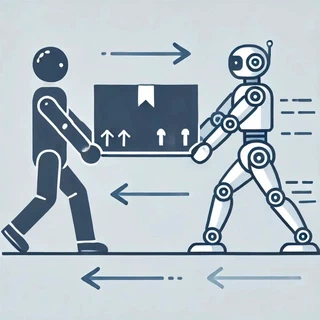
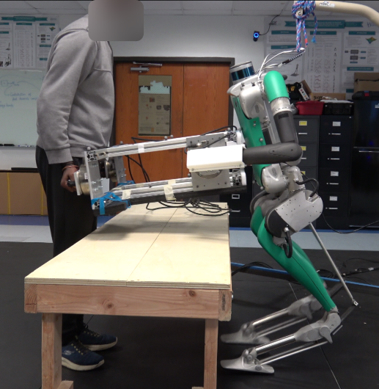
This project develops advanced control frameworks for humanoid robots that enable safe, compliant, and intuitive physical collaboration with humans during shared tasks such as joint object transportation and manipulation.
Key Contributions
- Novel I-LIP Modeling & MPC: Formulated the Interaction Linear Inverted Pendulum (I-LIP) model to generate adaptive footstep patterns for physical co-manipulation tasks.
- Hybrid MPC & Admittance Control Framework: Integrated Model Predictive Control with an admittance control model to dynamically adapt bipedal behavior in response to real-time interaction forces.
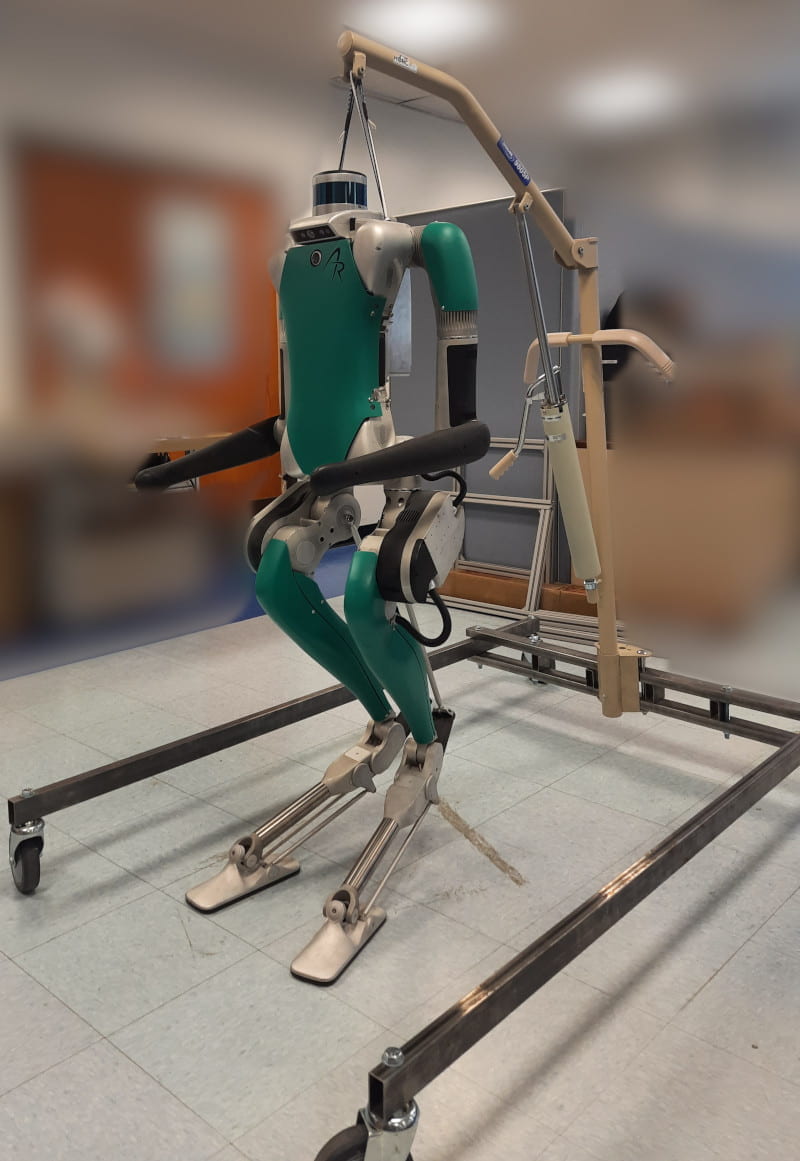
- Coupled Stability and Compliance: Designed an object-aware Whole Body Controller for the high-level plans of the Digit Humanoid to achieve simultaneous bipedal balance and compliant behavior during physical human-robot collaboration.
- Quantitative Collaboration Metric: Established an efficiency metric to jointly evaluate task performance and inter-agent coordination during dyadic transport.
- Full-Scale Experimental Validation: Demonstrated real-world execution on the Digit humanoid robot, proving that passive compliance enabled diverse dynamic maneuvers (forward motion, lateral shifts, turning) without prior knowledge of the human’s trajectory.
Media & Experimental Demos
Selected Publications
(see Publications for a complete list)
MPC-QP-based Control Framework for Compliant Behavior of Humanoid Robots in Physical Collaboration with Humans
Shubham Kumbhar and Panagiotis Artemiadis
IEEE International Conference on Robotics and Automation (ICRA), Atlanta, GA, 2025
[PDF]Toward Seamless Physical Human-Humanoid Interaction: Insights from Control, Intent, and Modeling with a Vision for What Comes Next
Gustavo A. Cardona, Shubham S. Kumbhar, and Panagiotis Artemiadis
Journal of Intelligent & Robotic Systems, 2026, [PDF]
Funding & Acknowledgments
This work has been supported by the following grants:
- NSF: 2020009, 2015786, 2025797, 201890, 2415093
- NIH: NIH 1R01HD111071-01
- Any opinions, findings, and conclusions expressed are those of the authors.