Human-Robot Interaction & Control Interfaces
Project Goal
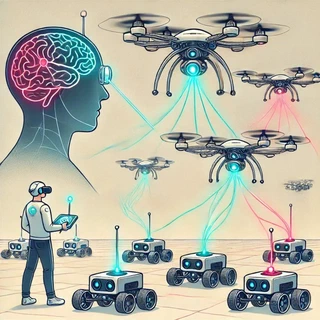
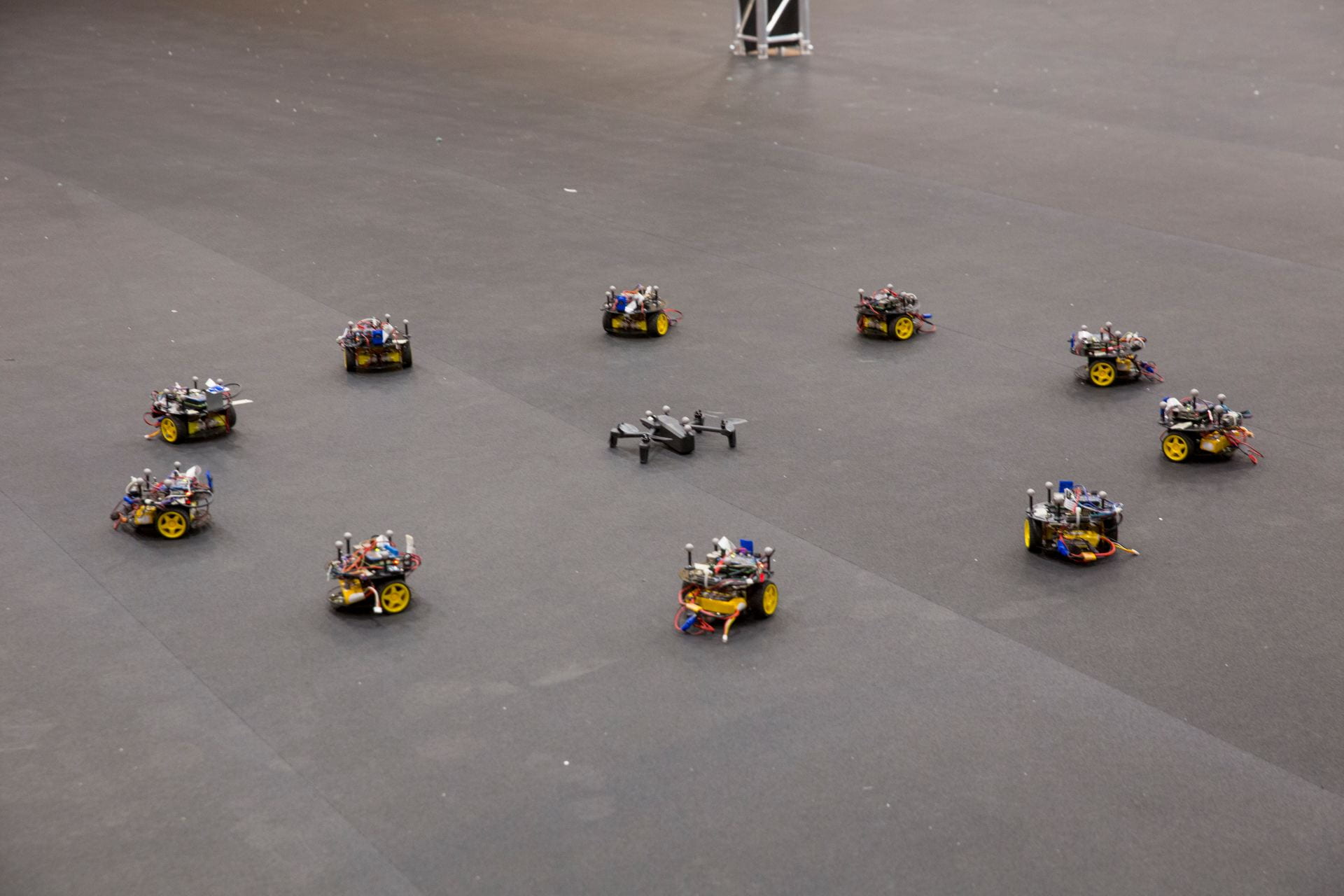
This project advances human-multi-agent interaction by creating intuitive, responsive control frameworks at the intersection of neuroscience, robotics, and machine learning. We integrate physiological intent decoding with distributed control to build scalable, low-cognitive-load interfaces for supervising complex multi-agent systems. Additionally, we apply adversarial machine learning using probing agents to actively discover and identify leader agents within dynamic multi-agent topologies.
Key Contributions
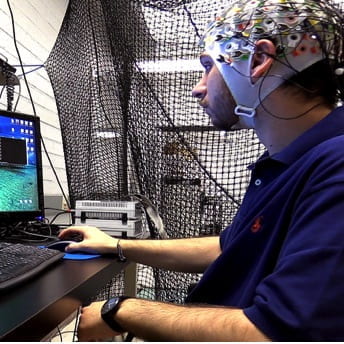
- EEG-Based Trust Quantification: Utilized electroencephalography (EEG) signals to decode, quantify, and model real-time human trust levels during human-multi-agent interaction.
- Brain-Machine Interface (BMI) Control: Formulated novel control methodologies leveraging brain-machine interfaces (BMI) for intuitive, direct human supervision of multi-agent systems.
- Adversarial Leader Identification: Developed the first learning-based framework for automatic leader identification, using deep reinforcement learning to train a physically interactive probing agent within partially observable multi-agent environments.
Media & Experimental Demos
Selected Publications
(see Publications for a complete list)
Extracting Human Levels of Trust in Human-Swarm Interaction using EEG signals
Jesus Orozco and Panagiotis Artemiadis
IEEE Transactions on Human-Machine Systems, vol. 54, no. 2, pp. 182–191, April 2024.
[PDF]Inferring imagined speech using EEG signals: a new approach using Riemannian manifold features
Chuong H. Nguyen, George K. Karavas, and Panagiotis Artemiadis
Journal of Neural Engineering, vol. 15, no. 1, 016002, 2018.
[PDF] [EEG Dataset]Learning Adversarial Policies for Swarm Leader Identification using a Probing Agent
Stergios Bachoumas and Panagiotis Artemiadis
IEEE International Conference on Robotics and Automation (ICRA), Atlanta, GA, 2025.
[PDF]
Funding & Acknowledgments
This work has been supported by the following grants:
- DARPA: D14AP00068
- AFOSR: FA9550-14-1-0149, FA9550-18-1-0221, FA9550-18-1-0464
- NSF: 2014264
- Any opinions, findings, and conclusions expressed are those of the authors.