Neural Human-Robot Interfaces for Intuitive Collaboration
Project Goal
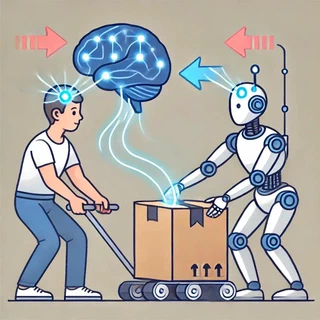
This project develops advanced human-robot interfaces that integrate neural signals and movement intent inference to enable seamless, intuitive physical collaboration during complex tasks.
Key Contributions
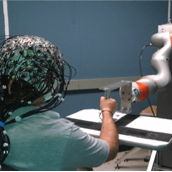
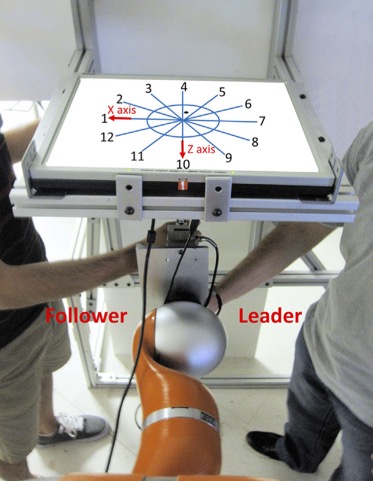
- Movement Intent Inference Algorithms: Developed algorithms to infer intended movement directions based on human-human physical interaction paradigms, enabling more intuitive human-robot collaboration.
- 6-DOF Physical Interaction Control: Formulated control strategies capable of managing complex, full six-degrees-of-freedom (6-DOF) physical interactions during shared tasks.
- Asymmetric Task Sharing & Role Allocation: Designed adaptive control frameworks that accommodate varying and unequal task contributions between human and robotic partners.
Selected Publications
(see Publications for a complete list)
Communication and Inference of Intended Movement Direction during Human-Human Physical Interaction
Keivan Mojtahedi, Bryan Whitsell, Panagiotis Artemiadis and Marco Santello
Frontiers in Neurorobotics, vol. 11 (21), pp. 1-12, 2017. [PDF]Physical Human–Robot Interaction (pHRI) in 6 DOF With Asymmetric Cooperation
Bryan Whitsell and Panagiotis Artemiadis IEEE Access, vol. 5, pp. 10834-10845, 2017. [PDF]Effective Neural Representations for Brain-Mediated Human-Robot Interactions
Christopher A. Buneo, Stephen Helms Tillery, Marco Santello, Veronica J. Santos, and Panagiotis Artemiadis In Neuro-robotics: From brain machine interfaces to rehabilitation robotics, as part of the Springer series on Trends on Augmentation of Human Performance, Artemiadis, P., Ed., New York:Springer, 2014, Vol. 2., pp. 207-237. Springer Netherlands, 2014.