Robot-assisted Gait Rehabilitation using the Variable Stiffness Treadmill

Project Goal
This project develops a novel post-stroke rehabilitation platform using the Variable Stiffness Treadmill (VST) to deliver targeted unilateral surface perturbations, evoking therapeutic motor responses in the impaired leg to increase step length and reduce drop-foot in mobility impaired individuals.
Key Contributions
- Demonstration of Lasting Motor Aftereffects: Proved that robot-assisted surface stiffness perturbations induce persistent sensorimotor adaptations, facilitating neural plasticity and improving inter-leg coordination post-stroke.
- Patient-Specific Rehabilitation Personalization: Established a framework for real-time, dynamic stiffness adjustment to tailor mechanical perturbations to an individual’s unique gait deficits and training needs.
- Mechanistic Insights into Mechanical Interventions: Advanced fundamental understanding of how targeted physical/mechanical perturbations engage neural pathways to correct post-stroke motor impairments.
- Translational Clinical Impact: Demonstrated a viable robotic intervention to improve functional mobility, step symmetry, and gait mechanics for hemiparetic patients.
Media & Experimental Demos
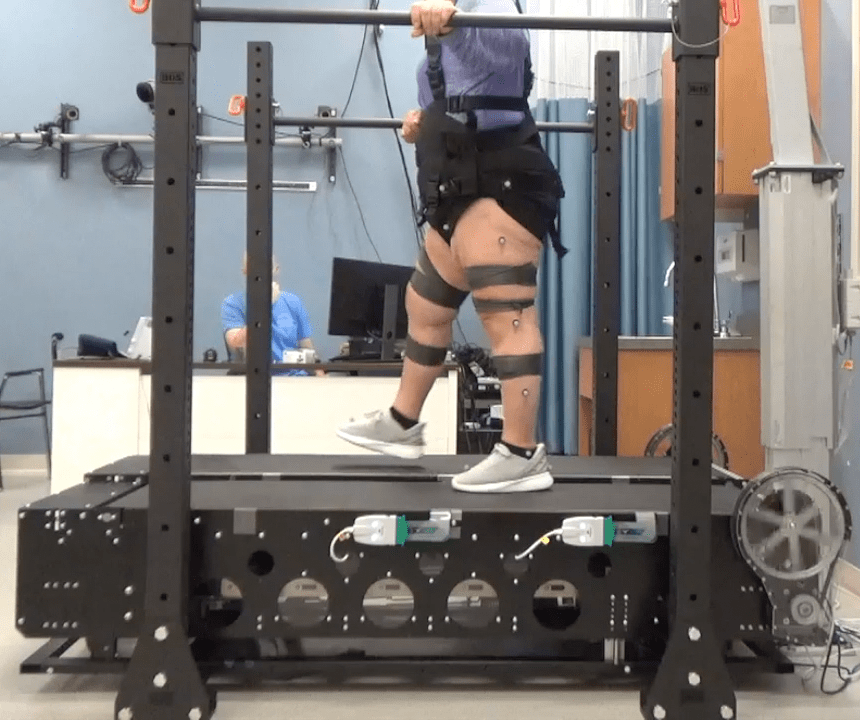
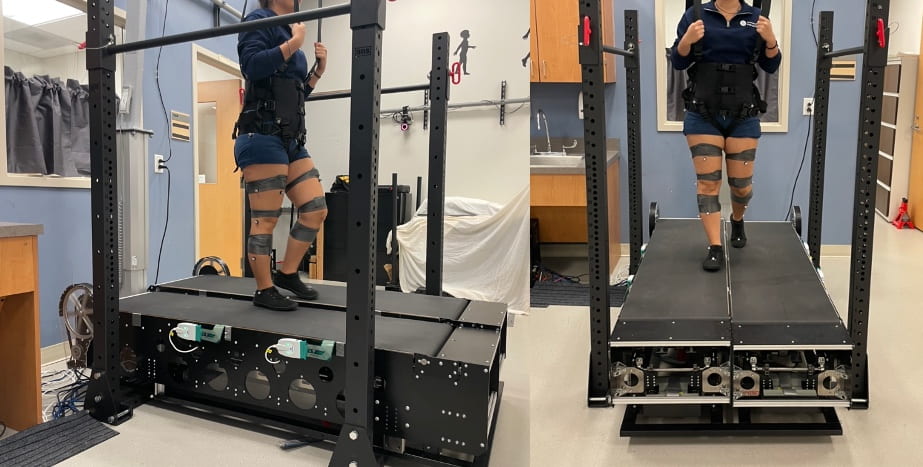
Selected Publications
(see Publications for a complete list)
The Variable Stiffness Treadmill (VST) 2: Development and Validation of a Unique Tool to Investigate Locomotion on Compliant Terrain
Vaughn Chambers, Bradley Hobbs, William Gaither, Zachary The, Anthony Zhou, Chrysostomos Karakasis, Panagiotis Artemiadis
J. Mechanisms Robotics, 2025.
[PDF]Using robot-assisted stiffness perturbations to evoke aftereffects useful to post-stroke gait rehabilitation
Vaughn Chambers and Panagiotis Artemiadis
Frontiers in Robotics and AI, 9, 2023. [PDF]Variable Stiffness Treadmill (VST): System Development, Characterization and Preliminary Experiments
Jeffrey Skidmore, Andrew Barkan and Panagiotis Artemiadis
IEEE/ASME Transactions on Mechatronics, vol. 20, issue 4, pp. 1717-1724, 2015. [PDF]
Funding & Acknowledgments
This work has been supported by the following grants:
- NSF: 2020009, 2015786, 2025797, 201890, 2415093
- NIH: NIH 1R01HD111071-01
- Any opinions, findings, and conclusions expressed are those of the authors.